
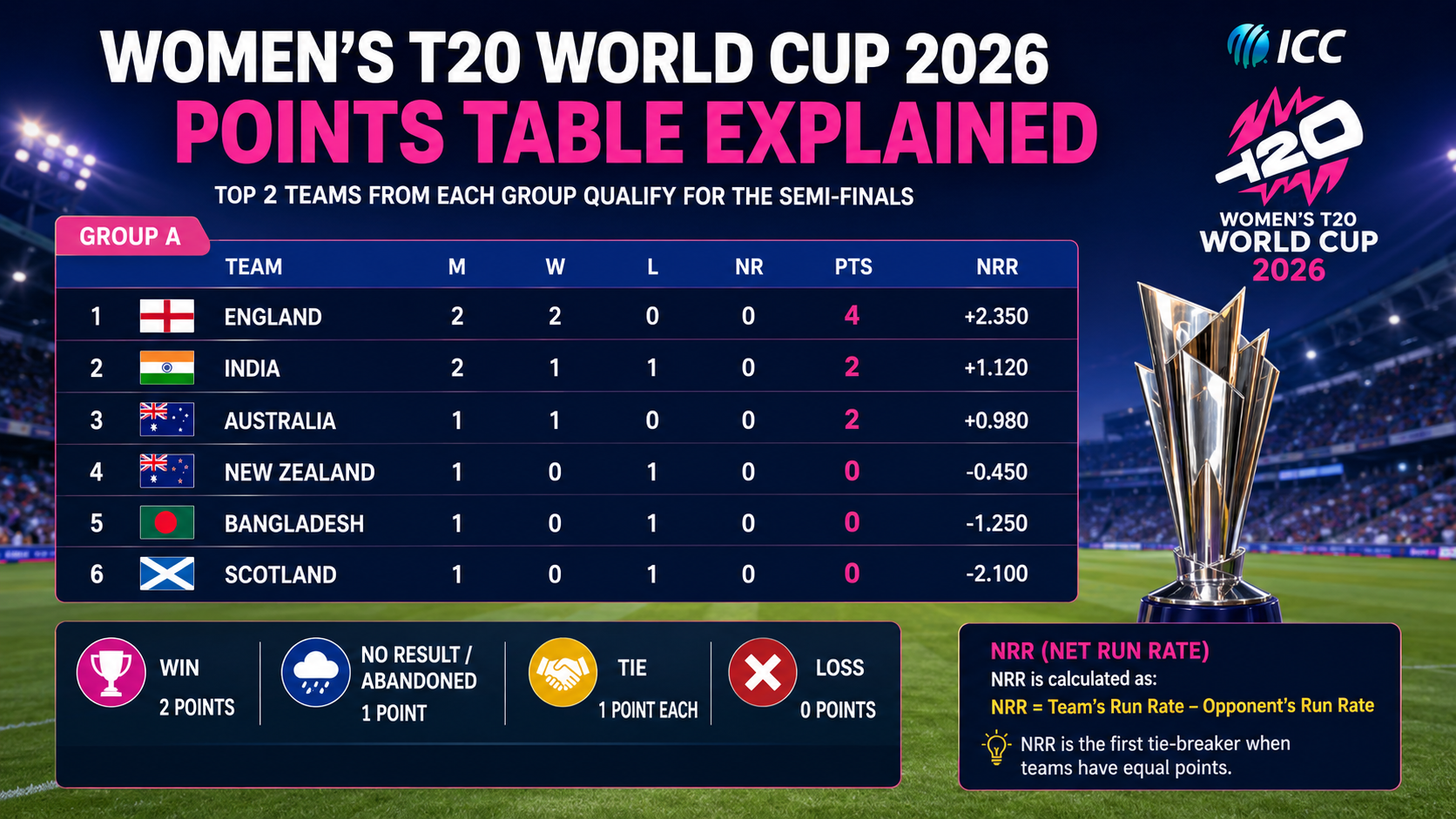
Women’s T20 World Cup 2026 Points Table Explained: Everything Fans Need to Know
The ICC Women’s T20 World Cup 2026 is set to be one of the most exciting tournaments in women’s cricket history. With more teams, tougher competition, and higher expectations, every match will play a crucial role in deciding which teams advance to the knockout stage. While fans often focus on match results and player performances, the points table remains the most important indicator of a team’s progress throughout the tournament.
Understanding how the Women’s T20 World Cup 2026 points table works can help fans follow qualification scenarios, predict semi-final contenders, and appreciate the importance of factors such as Net Run Rate (NRR). Here’s a complete breakdown of the standings system and what it means for participating teams.
What Is the Women’s T20 World Cup 2026 Points Table?
The points table is a ranking system used to track the performance of teams during the group stage of the tournament. Every match result directly affects a team’s position in the standings.
The 2026 Women’s T20 World Cup features 12 teams divided into two groups. Each team plays against every other team in its group, earning points based on match results. At the end of the group stage, the top-performing teams advance to the semi-finals.
Because only a limited number of teams can qualify for the knockout rounds, every point becomes valuable as the tournament progresses.
Women’s T20 World Cup 2026 Points System
The tournament follows a simple and widely used scoring format.
- Win: 2 Points
- No Result or Abandoned Match: 1 Point
- Tie: 1 Point Each
- Loss: 0 Points
This system rewards consistency. Teams that can string together multiple victories early in the tournament often place themselves in a strong position for qualification.
However, earning points alone is not always enough. When teams finish level on points, additional criteria are used to determine rankings.
Understanding Net Run Rate (NRR)
Net Run Rate, commonly known as NRR, is one of the most important aspects of any ICC tournament.
NRR measures how quickly a team scores runs compared to how quickly it allows opponents to score. A positive NRR indicates strong overall performance, while a negative NRR suggests that a team has been outperformed across its matches.
For example, a team that wins by large margins will usually enjoy a higher NRR than a team that wins close matches. Similarly, heavy defeats can significantly damage a team’s NRR.
In many ICC events, qualification has been decided by Net Run Rate rather than points alone. This makes every run and wicket crucial, even in matches that appear to be comfortably won.
How Teams Qualify for the Semi-Finals
The qualification process is straightforward but highly competitive.
At the end of the group stage:
- Teams are ranked according to total points earned.
- If teams are tied on points, Net Run Rate is used as the first tie-breaker.
- The top two teams from each group qualify for the semi-finals.
- Semi-final winners advance to the final.
This format means teams cannot afford lengthy losing streaks. A poor start often leaves little room for recovery later in the tournament.
Why the Points Table Changes Quickly
One of the reasons fans closely follow the standings is because positions can change dramatically after every match.
A team that starts the tournament with two consecutive wins can move to the top of the table. However, a single defeat combined with another team’s big victory can completely alter the rankings.
Factors that frequently influence the points table include:
Consecutive Victories
Winning multiple matches creates momentum and quickly increases a team’s qualification chances.
Large Winning Margins
Big victories improve Net Run Rate, which can become a decisive factor later in the tournament.
Rain-Affected Matches
Weather interruptions can result in shared points, creating unexpected qualification scenarios.
Key Head-to-Head Encounters
Matches between direct rivals often have a major impact on semi-final qualification.
Teams Expected to Challenge for the Knockout Stage
Several teams enter the Women’s T20 World Cup 2026 as strong contenders based on recent international performances.
India
India possesses one of the most balanced squads in women’s cricket. Their batting depth and improved bowling attack make them a serious title contender.
Australia
Australia remains one of the strongest teams in world cricket. Their experience in major tournaments gives them an advantage in pressure situations.
England
Playing in familiar conditions could help England perform consistently throughout the competition.
New Zealand
As defending champions, New Zealand will be determined to prove that their previous success was no coincidence.
South Africa
South Africa has emerged as a competitive force in recent ICC events and could challenge the traditional powerhouses.
West Indies
Known for their explosive batting, the West Indies are capable of upsetting any team on their day.
Why Fans Should Follow the Points Table Regularly
The Women’s T20 World Cup points table tells a story that goes beyond individual match results.
It reveals:
- Which teams are building momentum.
- Which sides are under pressure.
- Potential semi-final matchups.
- Qualification scenarios.
- The importance of Net Run Rate calculations.
As the tournament progresses, the standings often become the center of discussion among fans, analysts, and former players.
Looking Ahead
With an expanded tournament format and more teams competing for glory, the Women’s T20 World Cup 2026 promises intense competition from start to finish. Every match will influence the standings, making the points table one of the most closely watched aspects of the tournament.
Teams will not only aim to win matches but also improve their Net Run Rate to strengthen their chances of reaching the knockout stage. For fans, understanding the points table provides a deeper appreciation of the strategies, risks, and pressure involved in every game.
FAQs
What is the Women’s T20 World Cup 2026 points table?
The points table is a ranking system that tracks team performances during the group stage based on wins, losses, and Net Run Rate.
How many points are awarded for a win?
A team receives 2 points for every victory.
What happens if two teams finish with the same points?
Net Run Rate (NRR) is used to separate teams that are level on points.
How many teams qualify for the semi-finals?
The top two teams from each group advance to the semi-finals.
Why is Net Run Rate important?
NRR often acts as the deciding factor when multiple teams have the same number of points.
Where can I check the latest Women’s T20 World Cup 2026 standings?
Fans can follow the latest standings, fixtures, and results on the official ICC Women’s T20 World Cup website.
Final Thoughts
The Women’s T20 World Cup 2026 points table is much more than a list of rankings. It reflects a team’s consistency, ability to perform under pressure, and overall dominance throughout the tournament. With qualification likely to come down to small margins, every run, wicket, and point will matter. As the competition unfolds, keeping an eye on the standings will be just as important as watching the matches themselves.