T20 cricket has changed the way fans follow a match. With only 20 overs available to each side, every over can have a noticeable impact on the final score. This fast pace has also created several specialised cricket betting markets, including markets based specifically on the number of runs scored in the first innings.
For anyone new to this type of market, the basic idea is straightforward: instead of predicting which team will win the match, the focus is on how many runs the team batting first will score. Understanding how the market is structured, what influences the projected total, and how different match conditions affect scoring can make the terminology much easier to follow.
What Is a First Innings Runs Market?
A first innings runs market focuses on the total number of runs scored by the team batting first in a T20 match.
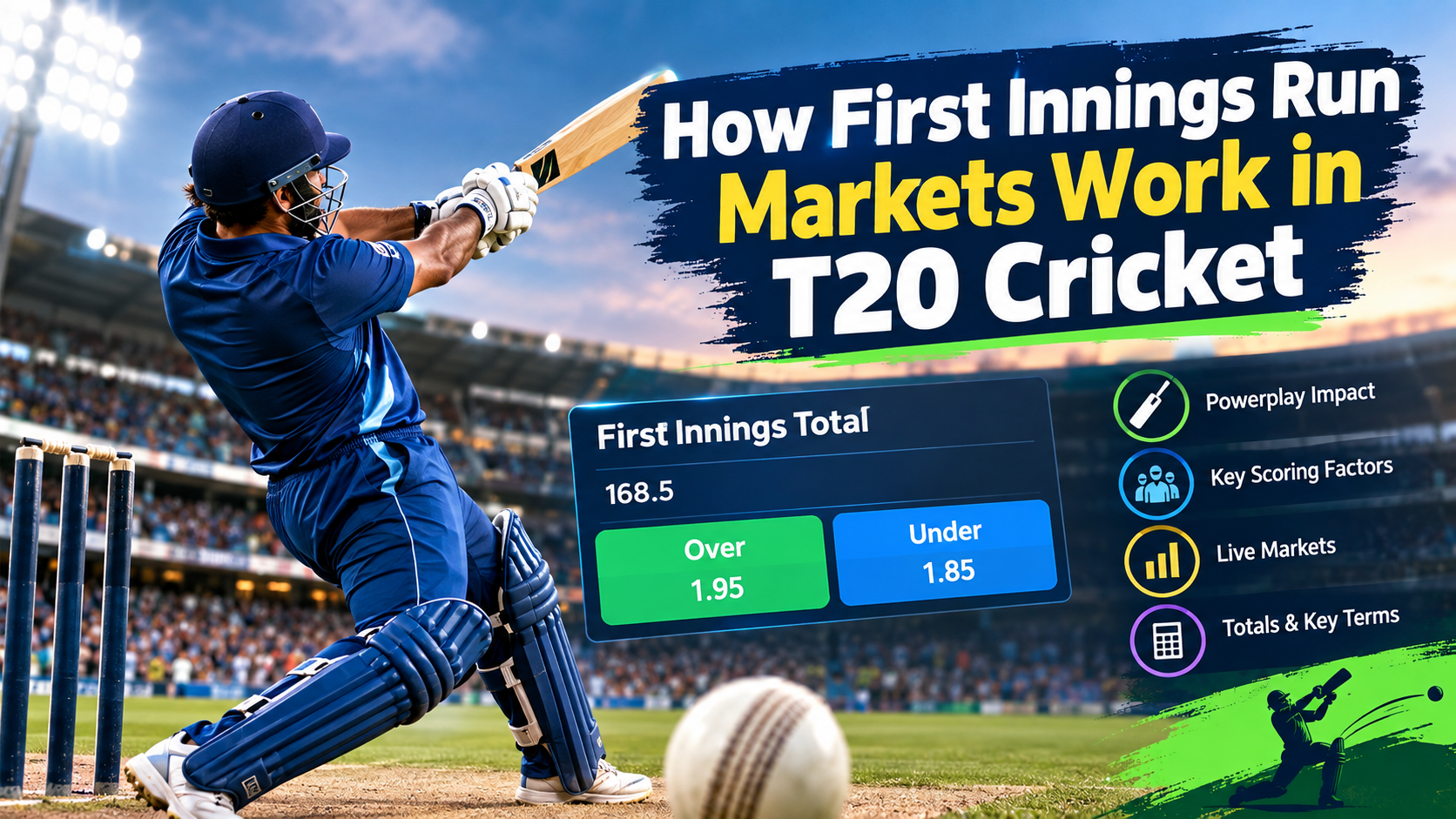
A betting operator may set a line such as 168.5 runs. The available selections could then be:
- Over 168.5
- Under 168.5
If the batting side finishes on 169 or more, the Over line is reached. If it finishes on 168 or fewer, the Under line is reached, subject to the operator’s specific settlement rules.
The important point is that this market is about the first batting innings rather than the overall match score. That makes it different from a match-total market, where the combined runs from both innings are considered.
Why T20 First Innings Markets Are Different
T20 cricket gives teams a limited number of overs, so scoring patterns can change rapidly. The first six overs are particularly important because of fielding restrictions, while the middle and final overs usually bring different batting and bowling approaches.
The ICC lists Men’s T20I playing conditions separately from other formats, making it important to understand the rules applying to the particular competition being followed.
A first innings total can therefore be influenced by several factors at once:
- Opening batting strength
- Bowling quality
- Pitch characteristics
- Ground dimensions
- Toss result
- Weather conditions
- Recent team scoring patterns
- Wickets lost during the innings
- Boundary frequency
- Batting depth
Looking at the total score alone may not provide the full picture. Two teams can reach the same score through very different scoring patterns.
The Importance of the Powerplay
The opening six overs can have a major effect on a T20 innings. During the powerplay, fielding restrictions create additional opportunities for attacking batters to find gaps and score boundaries.
For example, a team that reaches 55 runs from its first six overs starts with a considerably different scoring trajectory from a team that reaches only 35. However, the powerplay should not be treated as a guarantee of the final total.
A quick start can sometimes be followed by wickets in the middle overs, while a slower beginning may be recovered through aggressive batting later in the innings.
This is why first innings runs betting requires attention to the complete innings rather than relying on one phase alone.
How the Middle Overs Affect the Total
Overs seven to fifteen often provide a different type of challenge. Fielding restrictions are less restrictive, spinners may become more influential, and batters may balance boundary hitting with strike rotation.
The number of wickets remaining becomes particularly important during this stage.
If a team has several established batters at the crease, it may have greater flexibility to accelerate later. On the other hand, losing multiple wickets can force the batting side to rebuild rather than maintain an aggressive scoring rate.
The middle overs can therefore determine whether a strong powerplay develops into a high first-innings total or loses momentum.
The Role of Death Overs
The final five overs of a T20 innings can produce significant changes to the scoreboard. Batters often increase their attacking intent, while bowlers attempt to restrict boundaries through variations such as slower deliveries and yorkers.
A team with wickets in hand may have the opportunity to add a substantial number of runs during this period.
This is also why a first innings total should not be judged too early. A score that appears below expectations after 15 overs can change considerably during the final five.
Pre-Match and Live First Innings Markets
First innings markets can appear before a match begins and may also change while the innings is in progress.
Before the match, the projected line can reflect factors such as team composition, venue history, expected batting order and conditions.
During live play, the market can react to what is actually happening on the field. A rapid powerplay, an early wicket, a batting collapse or a series of boundaries can all change the projected total.
For anyone following live markets, it is important to remember that changing odds do not guarantee a particular outcome. They represent changing market expectations, and actual results can always differ.
A Simple Example
Suppose a T20 team is given a first innings total line of 172.5 runs.
The team scores:
- Powerplay: 48 runs
- Overs 7–15: 78 runs
- Overs 16–20: 51 runs
Its final total would be 177 runs.
The calculation itself is simple, but understanding why the total reached that level requires looking at the entire innings. The powerplay provided a foundation, the middle overs maintained the scoring rate, and the final five overs added further acceleration.
This illustrates why first innings markets are based on a measurable cricket outcome rather than simply predicting the match winner.
What Should Be Checked Before Following a Market?
Anyone researching T20 cricket betting markets should check the rules of the specific operator before placing any wager. Settlement conditions can differ, particularly when a match is shortened by weather or another interruption.
The ICC provides official playing-condition documents for international cricket, while individual betting platforms publish their own market and settlement rules.
It is also useful to check:
- Whether the market refers specifically to the first innings.
- Whether the line is an Over/Under total.
- How interrupted matches are handled.
- What happens if an innings is shortened.
- Whether the market is pre-match or live.
- Whether local laws permit the relevant activity.
For platform information and cricket-related market access, users may also refer to the official Cricbet99 website and check the applicable terms, availability and local requirements before using any service.
FAQs About First Innings Run Markets
What is a first innings runs market in T20 cricket?
It is a market based on the total number of runs scored by the team batting first. The operator normally provides a numerical line, with selections such as Over or Under.
How is the first innings total calculated?
The total is the number of runs scored by the batting team during its innings, subject to the applicable cricket rules and the operator’s settlement conditions.
Does the powerplay affect the first innings total?
Yes. The first six overs can influence the overall scoring rate because of fielding restrictions and the attacking approach of opening batters.
Can a first innings market change during a match?
Yes. Live markets can change as runs, wickets, required scoring rates and remaining overs alter the expected final total.
What happens if rain shortens a T20 match?
The treatment depends on the competition rules and the operator’s specific settlement rules. These should always be checked before participating in a market.
Is first innings betting the same as match-total betting?
No. A first innings market focuses on the score of the team batting first, whereas a match-total market generally considers runs from both innings.
Final Thought
First innings run markets add another statistical dimension to T20 cricket. Rather than focusing only on the eventual winner, they centre attention on scoring rate, wickets, powerplay performance, middle-over stability and late-innings acceleration.
For cricket followers, understanding these elements makes it easier to read a first-innings score and see how an innings develops from the opening delivery to the final over. Anyone considering a betting market should review the applicable rules, check local requirements and use responsible limits.