Understanding House Edge: What Every Casino Player Should Know
Whether you’re new to online casinos or have years of experience, you’ve probably heard the term house edge. Many players assume it means the casino always wins, but the concept is more nuanced than that. Understanding the house edge can help you make better decisions, manage your bankroll wisely, and choose games that offer better value over time.
The house edge isn’t a trick designed to prevent players from winning. Instead, it’s a mathematical advantage built into every casino game that allows casinos to operate profitably in the long run. Individual players can still enjoy winning sessions, but the odds are always slightly in the casino’s favor.
In this guide, we’ll explain what the house edge means, how it works, why it matters, and how you can use this knowledge to become a smarter player.
What Is the House Edge?
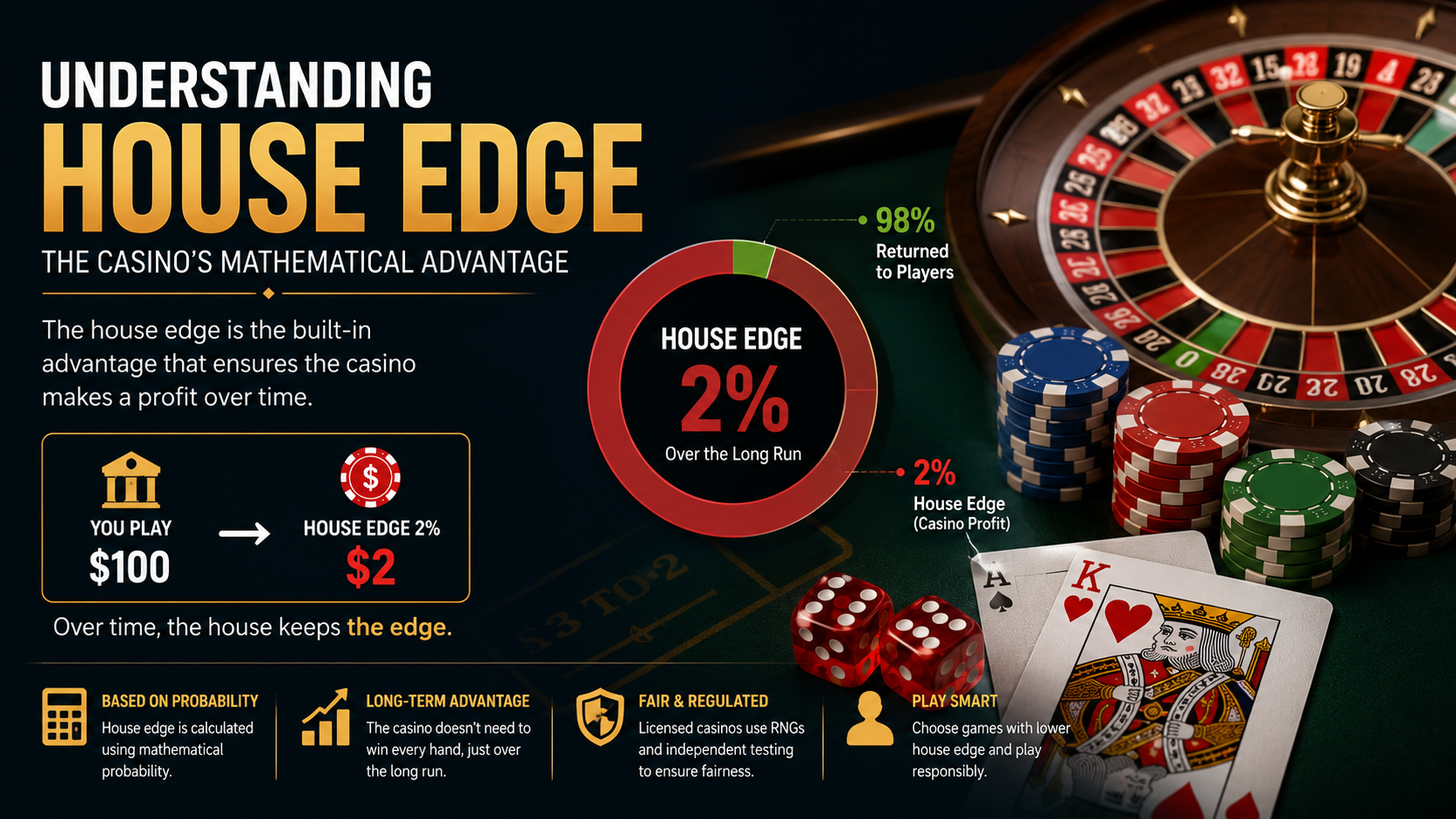
The house edge is the percentage of every wager that a casino expects to keep over the long term. It represents the casino’s average profit from each game after thousands or even millions of bets.
For example, if a game has a 2% house edge, the casino expects to earn about $2 for every $100 wagered over a long period. This does not mean you’ll lose $2 every time you bet $100. Results in individual sessions are based on chance, and players can win or lose much more than the expected average.
The house edge simply reflects the game’s mathematical expectation over many rounds.
How Does the House Edge Work?
Casino games are built around probability. Every possible outcome has a specific likelihood, and the payouts are designed so that the casino retains a small statistical advantage.
Imagine flipping a fair coin. If heads and tails both paid even money, neither side would have an advantage.
Casino games work differently. While the outcomes are random, the payouts are structured so that the expected return to players is slightly less than 100%. The difference between 100% and the expected return is known as the house edge.
This small percentage allows casinos to remain profitable while still giving players opportunities to win.
House Edge vs. RTP
Many players confuse House Edge with Return to Player (RTP).
The relationship is simple:
House Edge = 100% − RTP
For example:
- RTP: 96%
- House Edge: 4%
A higher RTP generally means a lower house edge, making the game more favorable for players over time.
You can learn more about RTP from the Cricbet99 guide
House Edge in Popular Casino Games
Different casino games have different house edges.
| Casino Game | Approximate House Edge |
| Blackjack (Optimal Strategy) | 0.5% |
| Baccarat (Banker Bet) | 1.06% |
| Craps (Pass Line) | 1.41% |
| European Roulette | 2.70% |
| Blackjack (Without Strategy) | 2%–5% |
| American Roulette | 5.26% |
| Most Slot Games | 2%–10% |
| Keno | 20%–35% |
As you can see, games involving player decisions, such as blackjack, often have a lower house edge when played with the correct strategy.
Why the House Edge Matters
Understanding the house edge helps players make informed decisions instead of relying on myths or lucky streaks.
Some of the biggest benefits include:
- Choosing games with better long-term value.
- Setting realistic expectations.
- Managing your bankroll more effectively.
- Avoiding games with unnecessarily high built-in disadvantages.
- Making entertainment-focused decisions rather than chasing losses.
The house edge doesn’t predict what will happen during your next session, but it provides valuable insight into what to expect over time.
Can You Beat the House Edge?
For most casino games, the answer is no.
The house edge is built into the game’s mathematical design and cannot be eliminated.
However, players can reduce its impact by:
- Learning the optimal strategy for blackjack.
- Choosing European Roulette instead of American Roulette.
- Betting on the Banker hand in baccarat.
- Selecting slot games with high RTP percentages.
- Avoiding side bets that often carry much larger house edges.
- Playing within a predetermined budget.
These decisions won’t guarantee profits, but they can improve your overall playing experience.
Common Myths About House Edge
Myth 1: The Casino Controls Individual Results
Licensed casinos use certified Random Number Generators (RNGs) to ensure outcomes remain random. The house edge exists regardless of short-term wins or losses.
Myth 2: A Losing Streak Means a Big Win Is Coming
Each spin, card, or roll is independent. Previous outcomes do not influence future results.
Myth 3: Bigger Bets Reduce the House Edge
Increasing your wager size only increases the amount of money exposed to the same mathematical advantage.
Myth 4: Winning Systems Remove the House Edge
Popular betting systems like Martingale or Fibonacci change betting patterns but do not alter the underlying probabilities of the game.
How Casinos Stay Profitable
Casinos don’t depend on every player losing.
Instead, they rely on:
- Millions of bets placed daily.
- A consistent mathematical advantage.
- Large numbers of players.
- Long-term statistical averages.
This is why casinos can comfortably pay out significant jackpots while still operating profitably over many years.
Tips for Playing Smarter
While no strategy guarantees consistent winnings, these habits can improve your experience:
- Compare RTP before choosing slot games.
- Learn the rules and strategy of skill-based games.
- Set deposit and loss limits before playing.
- Take breaks during long sessions.
- Treat casino gaming as entertainment rather than income.
- Avoid chasing losses after an unlucky streak.
Responsible gambling always leads to a healthier gaming experience.
FAQs
What does house edge mean in a casino?
House edge is the mathematical advantage a casino has over players over a long period. It represents the percentage of wagers the casino expects to retain.
Is a lower house edge always better?
Generally, yes. A lower house edge means better long-term value for players, although short-term outcomes remain unpredictable.
Which casino game has the lowest house edge?
Blackjack typically offers one of the lowest house edges when played using optimal basic strategy.
Does RTP guarantee my winnings?
No. RTP is calculated across millions of game rounds and does not predict individual results.
Can strategy completely eliminate the house edge?
No. Strategy can reduce the house edge in some games, but it cannot remove the casino’s built-in mathematical advantage.
Final Thought
Understanding the house edge is one of the most valuable lessons for anyone interested in casino games. Instead of focusing solely on winning or losing individual sessions, it’s important to recognize how probability influences long-term results. By choosing games with lower house edges, learning proper strategies, and practicing responsible bankroll management, players can enjoy a more informed and balanced gaming experience. While luck will always play a role in the short term, knowledge remains one of the best tools for making smarter decisions at the casino.