
Cricket betting has moved well beyond simply predicting which team will win a match. Modern cricket betting markets allow fans to focus on individual players and predict specific performances, from runs and wickets to catches and other statistical outcomes. These are commonly known as player performance markets.
For cricket followers who regularly watch a player’s form, role, batting position or bowling workload, these markets can be more interesting than traditional match-result bets. However, understanding how the market is calculated is important before making any decision.
What Are Player Performance Markets in Cricket Betting?
Player performance markets are betting options based on the statistics or achievements of an individual cricketer during a particular match.
Instead of predicting the winner, a bettor might be asked to predict whether a batter will score over or under a certain number of runs, whether a bowler will take a specific number of wickets, or whether a player will reach a combined performance target.
Common examples include:
- Player total runs
- Player total wickets
- Player to score 50 or 100
- Player to take two or more wickets
- Player to hit a certain number of sixes
- Player to take a catch
- Top batter or top bowler
- Combined player performance points
The exact markets and settlement rules vary between betting operators, so the terms should always be checked before placing a bet.
How Does a Player Performance Market Work?
The basic idea is straightforward. A bookmaker sets a statistical line based on factors such as a player’s recent performances, expected role, opposition, match conditions and historical data.
For example, suppose a batter has a player-runs line of 32.5 runs.
The available options could be:
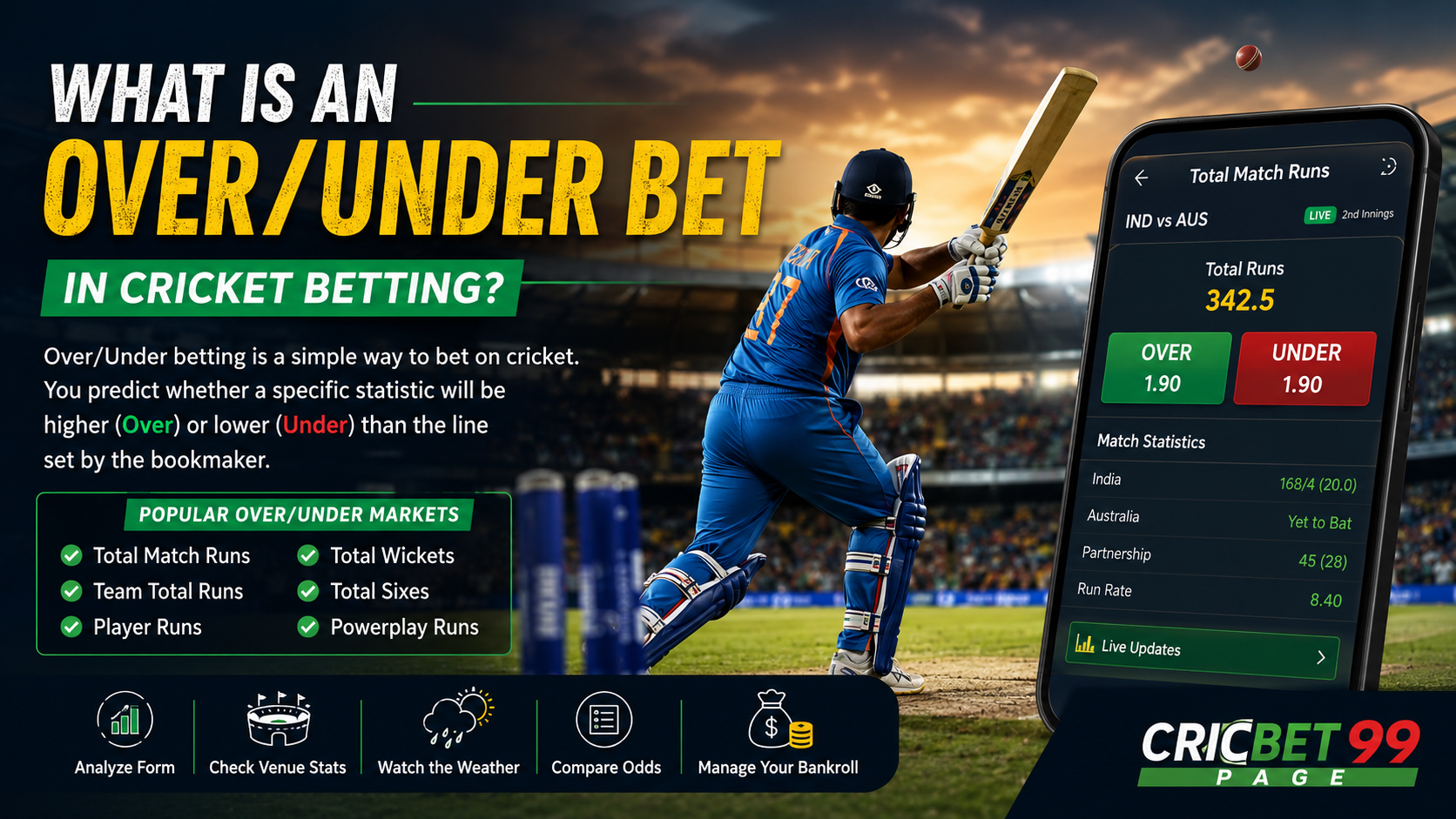
- Over 32.5 runs
- Under 32.5 runs
If the player scores 45 runs, the Over selection wins. If the player scores 20 runs, the Under selection wins.
The same principle can apply to wickets, sixes, catches and other statistics. Some operators also combine several statistics into one player performance score.
One important point is that not every bookmaker calculates performance markets in the same way. Some may use their own scoring formula, while others offer individual statistical markets instead. This makes reading the market rules particularly important.
The Main Types of Player Performance Markets
1. Player Runs
Player runs are among the easiest performance markets to understand. The bet is based on how many runs a specific batter scores.
A bettor may see lines such as 24.5, 39.5 or 50.5 runs. The relevant factors include batting position, recent form, expected innings length and the quality of the opposing bowling attack.
A top-order batter generally has more opportunity to face deliveries than a player batting at No. 7 or No. 8, but opportunity does not guarantee a particular result.
2. Player Wickets
Bowling markets focus on the number of wickets a particular bowler takes.
For example, a market might offer Over or Under 1.5 wickets. A bowler taking two wickets would clear the Over line.
Role matters significantly here. A bowler expected to deliver four overs in a T20 match has a different opportunity profile from a part-time bowler who may not bowl at all.
3. Player Milestones
Milestone markets focus on achievements such as scoring 50 or 100 runs.
These markets can look attractive because they are easy to understand, but reaching a milestone depends on several events. A batter must first get enough time at the crease, survive the opposition attack and maintain their scoring rate.
4. Player Performance Points
Some cricket betting markets combine batting, bowling and fielding statistics into one points-based system.
For instance, an operator may assign points for runs, wickets and catches. The exact scoring system is not universal, so bettors should never assume that one bookmaker uses the same formula as another.
This type of market can be particularly interesting for all-rounders because one player can contribute in multiple areas.
What Factors Influence Player Performance?
Looking at a player’s previous score alone is rarely enough to understand a performance market.
Recent Form
Recent performances can provide useful context, although a short run of good or bad results does not guarantee what happens next. A player’s form should be considered alongside their role and match conditions.
Batting Position
Batting order can dramatically influence opportunity. An opener may have considerably more time to score runs than a lower-order batter.
Bowling Role
For bowlers, the number of expected overs and when those overs are likely to be delivered can matter. New-ball bowlers, death-overs specialists and middle-overs spinners all operate in different conditions.
Pitch and Weather
Pitch characteristics can influence both batting and bowling. A surface offering movement may benefit certain bowlers, while a flat pitch may provide better scoring opportunities.
Weather can also affect playing conditions and the amount of time available in a match.
Opposition Matchups
A player’s record against particular bowling styles or batting opponents can add another layer to analysis. However, historical statistics should be treated as context rather than a guarantee of future performance.
The ICC’s explanation of player rankings and performance calculations is also useful for understanding how cricket performance can be evaluated using multiple factors rather than a single statistic.
Player Performance Markets vs Match Winner Markets
The biggest difference is the outcome being predicted.
A match-winner market asks which team will win. A player performance market focuses on an individual’s statistical contribution.
This means a player can have a strong performance even when their team loses. For example, a batter could score 80 runs in a losing side, while a bowler could take three wickets despite their team being defeated.
This distinction is important because player markets require a different type of analysis. Instead of concentrating mainly on team strength, bettors need to consider individual roles, opportunities and statistical trends.
Why Understanding Market Rules Matters
One of the most overlooked parts of player performance betting is the settlement rule.
Questions worth checking include:
- What happens if the player does not play?
- Does the bet require the player to take the field?
- What happens if rain reduces the number of overs?
- Are super overs included?
- How are abandoned matches settled?
- Are catches or assists counted under the market?
- What scoring system is used for performance points?
These rules can differ between operators. Reading them before placing a bet can prevent confusion later.
Responsible Approach to Player Performance Betting
Player performance markets should be treated as a form of entertainment rather than a guaranteed way to make money. Cricket contains considerable uncertainty, and even detailed statistical analysis cannot predict every outcome.
A sensible approach is to understand the market first, set a personal spending limit and avoid increasing stakes simply because a previous prediction was unsuccessful. Anyone considering cricket betting should also check the laws and age requirements applicable in their location.
For readers looking to explore cricket betting markets and sports betting information, CricBet99’s sports section provides another place to browse cricket-related betting topics and market information.
FAQs
What is a player performance market in cricket betting?
A player performance market is a betting market based on an individual player’s statistics or achievements during a cricket match. It can involve runs, wickets, catches, milestones or combined performance points.
Are player performance markets available in all cricket formats?
Availability depends on the betting operator. Player markets can appear across T20s, ODIs and Test matches, although the range of available options may vary between formats.
Does batting position affect player performance bets?
Yes. Batting position can influence how many deliveries a player is likely to face. However, it is only one factor among many, including opposition quality, pitch conditions and match situation.
Are player performance points the same at every bookmaker?
No. Performance-point systems can differ between operators. Always check the specific scoring and settlement rules before making a selection.
Can a player perform well even if their team loses?
Absolutely. A batter can score heavily or a bowler can take several wickets even when their team does not win. This is one of the key differences between player performance markets and match-winner markets.
Final Thought
Player performance markets add another layer to cricket betting by shifting attention from the final result to individual contributions. They can be particularly interesting for people who enjoy analysing player roles, recent statistics, matchups and playing conditions.
However, statistics should support understanding rather than create a false sense of certainty. A player’s form, position, workload and conditions can all change quickly, which is why no single statistic should be treated as a guaranteed indicator.
The best starting point is to understand exactly what a market measures, check its settlement rules and approach every selection with realistic expectations. When combined with responsible betting habits, that knowledge makes player performance markets much easier to understand.