Cricket is a game of momentum, and a single wicket can completely change the direction of an innings. That is one reason Fall of Wicket betting markets have become an interesting part of cricket betting. Instead of focusing only on who will win a match, these markets look at a much smaller event: when a particular wicket is likely to fall and how many runs the batting side may have scored at that moment.
For anyone new to cricket betting, this market can seem complicated at first. However, once the basic terms are understood, Fall of Wicket markets become much easier to follow. They also encourage bettors to pay closer attention to partnerships, pitch conditions, bowling changes and the current scoring rate.
What Is a Fall of Wicket Market?
In cricket, a fall of wicket refers to the moment when a batter is dismissed. The score at that point becomes an important part of the match record. The International Cricket Council’s playing laws explain how a wicket is considered to be put down and how dismissals are recorded during an innings.
In betting markets, this event can be turned into several different predictions.
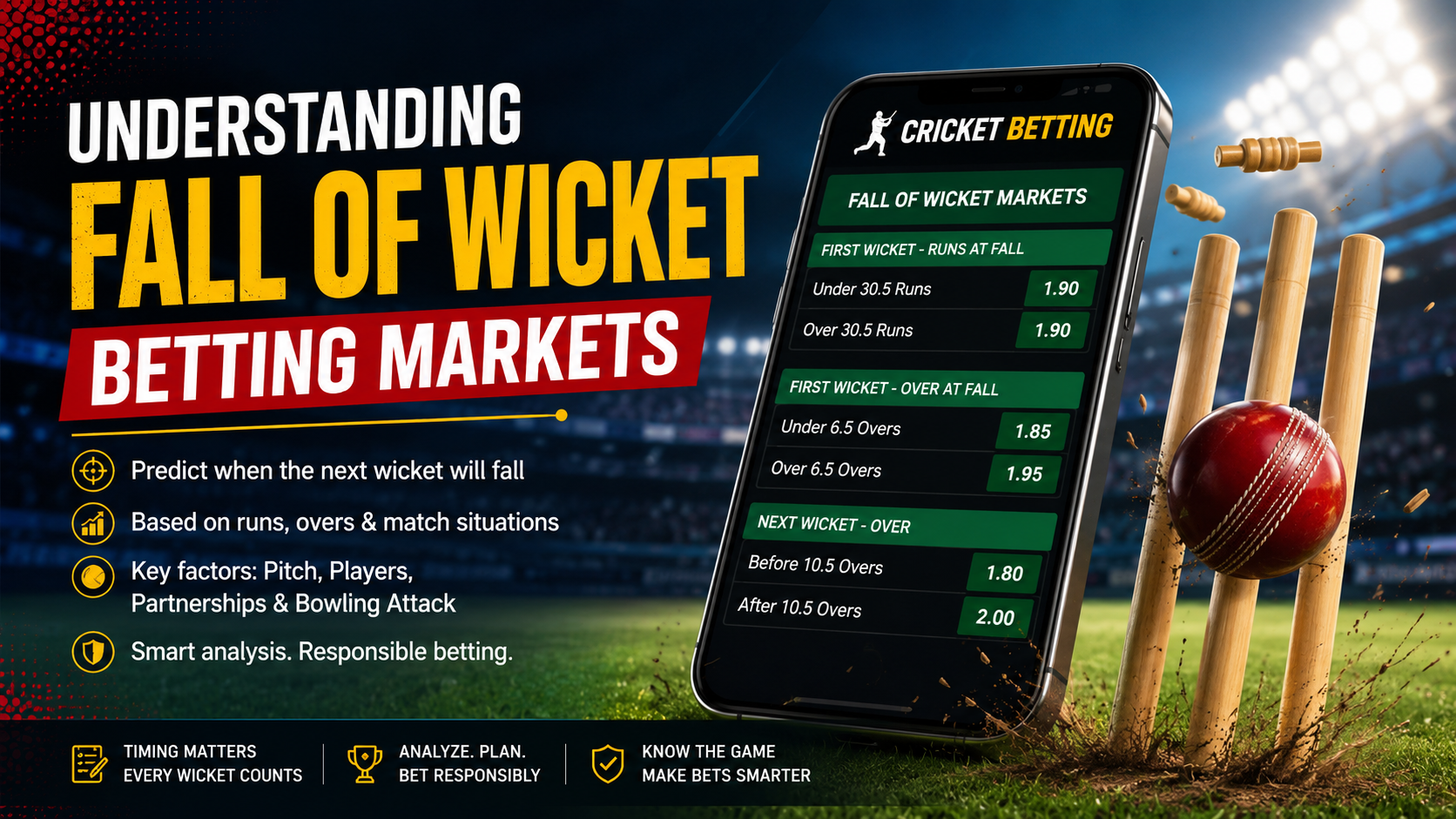
For example, a sportsbook may offer a market asking whether the first wicket will fall before or after a certain number of runs. Another version may focus on the over in which the next wicket occurs.
A hypothetical market could look like:
- First wicket under 30.5 runs
- First wicket over 30.5 runs
- Next wicket before the 10th over
- Next wicket after the 10th over
The exact options depend on the sportsbook and match format.
How Does Fall of Wicket Betting Work?
The basic idea is simple: you are predicting the point at which a wicket will fall.
Suppose a team is batting at 27/0 after six overs and the market line for the first wicket is 32.5 runs. If the opening partnership is broken when the score reaches 31, the under selection would be successful. If the wicket falls at 34, the over selection would be the winning side of the market, subject to the sportsbook’s settlement rules.
Some markets are based on runs at fall of wicket, while others use the over at fall of wicket.
For example, official cricket betting rules commonly define an over-based market according to the over in which the wicket occurs. A dismissal at 46.2 overs, for instance, can be settled as the 47th over.
This distinction is important because cricket uses six legal deliveries in a standard over, and the notation can be confusing to newcomers.
Why Do Fall of Wicket Markets Attract Attention?
The biggest attraction is that the market focuses on one specific phase of an innings rather than the entire match.
A match-winner prediction may depend on dozens of factors over several hours. A Fall of Wicket market has a narrower outcome. Bettors can instead study the opening partnership, batting order, bowling attack and conditions before making a prediction.
For example, if two aggressive opening batters are facing a strong new-ball attack, the possibility of an early wicket may receive more attention. On a flat pitch with two well-set openers, the first wicket could potentially arrive much later.
Of course, these factors do not guarantee an outcome. Cricket remains unpredictable, and even a strong statistical argument can be overturned by one delivery.
Factors That Can Influence the Fall of a Wicket
Several match conditions can affect this type of market.
Opening Partnership
The first few overs can provide useful context. A strong partnership may push the first-wicket score higher, while early movement for fast bowlers can create opportunities for dismissals.
Pitch Conditions
A pitch offering assistance to seamers or spinners can influence how easily batters score and survive. A high-scoring surface may produce longer partnerships, while difficult batting conditions can increase wicket pressure.
Bowling Attack
The quality and style of the bowlers matter. A team with experienced new-ball bowlers may create different conditions for the opening wicket than a side relying heavily on spin.
Scoring Rate
Run rate is another useful indicator. If a team is scoring quickly during the powerplay, a wicket may arrive at a higher score than expected simply because more runs have been accumulated before the dismissal.
Match Format
T20, ODI and Test cricket have very different scoring patterns. A Fall of Wicket market should therefore be viewed within the context of the format rather than treated as the same market across every match.
Fall of Wicket vs Next Wicket
These two markets can sound similar but may refer to different predictions.
A Fall of Wicket market usually focuses on the score or over at which a specified wicket falls. A Next Wicket market can instead focus on which batter will be dismissed next.
For example:
- Fall of First Wicket: Will the first wicket fall before or after 35 runs?
- Over at Next Wicket: In which over will the next dismissal occur?
- Next Batter Out: Which batter is most likely to be dismissed next?
The settlement rules should always be checked before selecting a market because individual sportsbooks can have different conditions for rain interruptions, declarations, targets and abandoned matches.
How to Approach These Markets Responsibly
The most useful approach is to treat Fall of Wicket betting as an analytical market rather than a guaranteed opportunity.
Before making any decision, consider the current score, wickets in hand, partnership, recent overs, bowling changes, pitch conditions and required run rate. Live markets can change rapidly after a boundary, dropped catch or bowling change.
It is also important to understand the difference between a cricket prediction and a financial wager. A prediction is simply an opinion about what may happen. Betting involves financial risk, so users should understand the rules that apply in their location and the specific terms of the service they use.
Those researching different cricket markets can explore resources such as Cricbet99 cricket betting to understand how cricket betting categories are structured. The site currently lists markets including match winner, session, toss, over/under and player-performance betting.
Common Mistakes to Avoid
One common mistake is looking only at the average first-wicket score without considering the teams involved. Historical numbers can provide context, but they do not automatically predict the next match.
Another mistake is ignoring live match developments. A team that starts cautiously may suddenly accelerate after a bowling change. Similarly, a dropped catch can change the expected direction of an innings.
Finally, bettors should never assume that every sportsbook settles a Fall of Wicket market in exactly the same way. Checking the market rules before placing a wager is essential.
FAQs
What is Fall of Wicket betting?
Fall of Wicket betting involves predicting an aspect of when a wicket will fall, such as the score or over at which a specified dismissal occurs.
What does “runs at fall of wicket” mean?
It refers to the number of runs scored by the batting team when the specified wicket falls. The exact settlement method depends on the sportsbook’s rules.
Is Fall of Wicket available in live cricket betting?
It can be. Some sportsbooks offer live or in-play Fall of Wicket markets, although availability varies by match, format and operator.
What factors should be considered?
Pitch conditions, batting partnerships, bowling quality, scoring rate, match format and the current match situation can all provide useful context.
Are Fall of Wicket markets guaranteed?
No. Cricket contains considerable uncertainty, and statistics or match analysis cannot guarantee a particular result.
Final Thought
Fall of Wicket betting markets offer a more focused way to follow cricket than simply predicting the match winner. By concentrating on wickets, scoring patterns and specific stages of an innings, these markets can add another analytical dimension to watching a game.
The key is understanding exactly what a market means before making a selection. Once the difference between runs at fall of wicket, over at fall of wicket and next-wicket markets is clear, the terminology becomes much easier to follow. Combining that understanding with match conditions, current form and responsible decision-making can make cricket betting analysis more informed and structured.