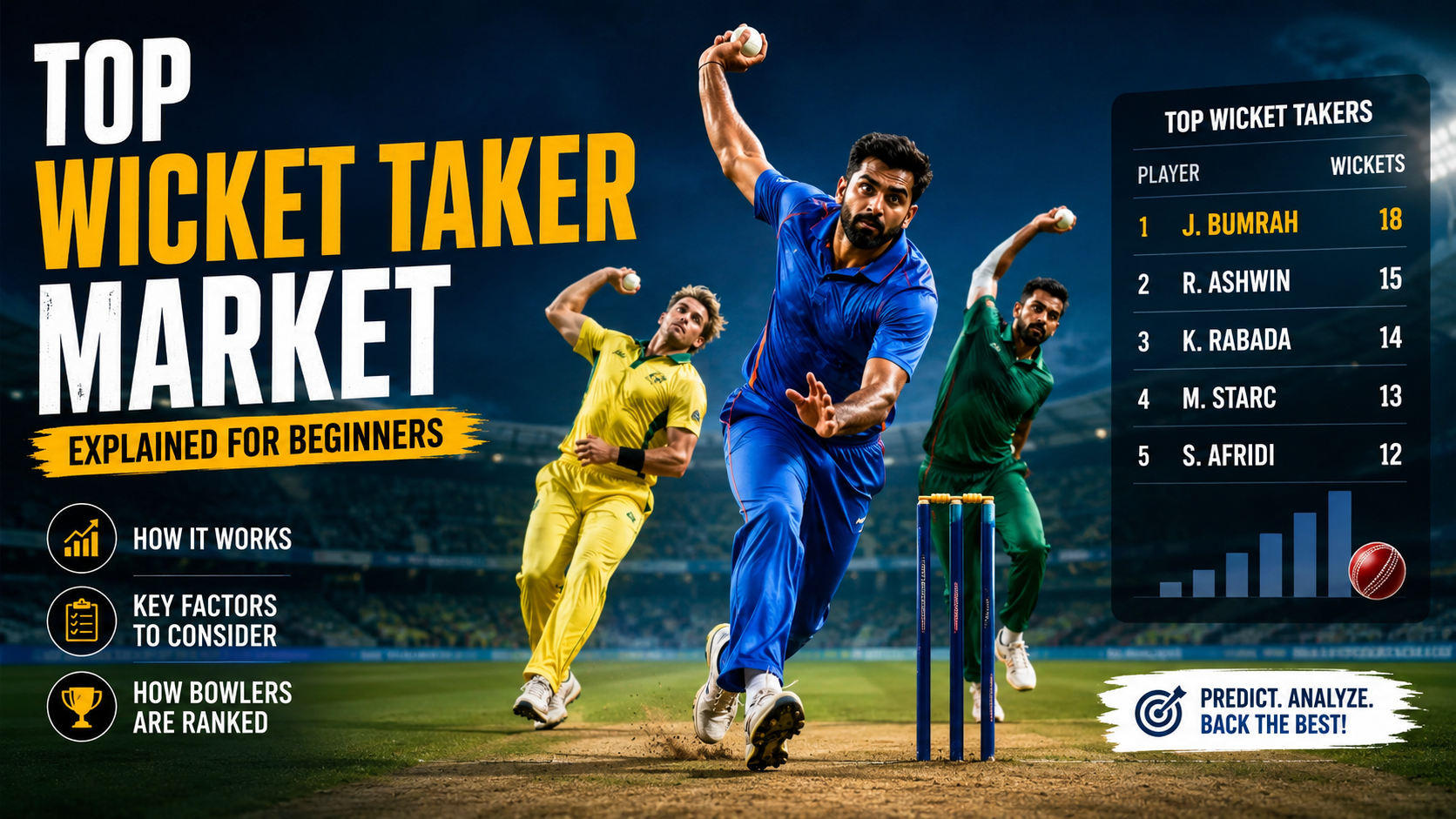
Cricket offers many markets based on individual player performances, and the Top Wicket Taker Market is one of the easiest to understand. Instead of predicting which team will win the match, this market focuses on the bowlers and asks a simple question: Which player will take the most wickets?
For cricket fans who closely follow bowling form, pitch conditions, team combinations, and player roles, this market adds another layer to match analysis. However, understanding how the market is settled is important before considering any wager.
This guide explains how the Top Wicket Taker Market works, what factors can influence the result, and what beginners should check before making a prediction.
What Is the Top Wicket Taker Market?
The Top Wicket Taker Market is a player-performance market where participants predict the bowler who will take the highest number of wickets in a specific match.
For example, imagine a T20 match with these bowlers:
- Bowler A – 3 wickets
- Bowler B – 2 wickets
- Bowler C – 1 wicket
- Bowler D – 0 wickets
In this situation, Bowler A finishes as the top wicket taker because they have taken more wickets than any other bowler in the match.
The exact market rules can vary between operators. Some markets may have specific settlement rules for ties, abandoned matches, or players who do not participate. That is why checking the relevant terms is always important.
How Does the Top Wicket Taker Market Work?
The basic idea is straightforward.
Before a match begins, a sportsbook may list several bowlers along with odds. Each player is assigned odds based on factors such as recent performances, expected overs, opposition strength, pitch conditions, and general market expectations.
A player predicted to have a stronger chance of taking the most wickets may be assigned shorter odds, while a bowler considered less likely to finish first may have longer odds.
However, shorter odds do not guarantee that a player will become the top wicket taker. Cricket is unpredictable, and a bowler can have an excellent record but still go wicketless in a particular match.
The final result depends on the official match outcome and the settlement rules of the relevant market.
Why Bowler Selection Matters
One of the biggest mistakes beginners make is choosing a bowler only because of their reputation. A famous bowler may not always be the best option for a particular match.
Instead, it helps to look at the player’s role.
A bowler who regularly completes their full allocation of overs may have more opportunities to take wickets than someone who is only used occasionally. In T20 cricket, death-over specialists can also become interesting because batters often take greater risks during the final overs.
Similarly, a new-ball bowler may have opportunities against top-order batters before they settle into their innings.
Before analysing any player market, it is useful to check:
- Expected number of overs
- Recent bowling form
- Match format
- Pitch and surface conditions
- Opposition batting lineup
- Player availability
- Bowling role within the team
These factors do not guarantee an outcome, but they can help create a more informed analysis.
The Importance of Pitch Conditions
The playing surface can significantly affect bowling conditions.
A dry pitch may provide more assistance to spin bowlers, while a surface with pace and movement can create opportunities for fast bowlers. Some grounds also have conditions that historically favour high-scoring matches, which may force bowlers to take more risks.
Weather can matter as well. Cloud cover, moisture, or other conditions may influence how the ball behaves, particularly in longer formats.
That is why analysing the venue is often more useful than simply looking at a player’s overall career record.
A bowler who has a moderate overall record may perform particularly well on a surface that suits their style.
Recent Form vs Overall Statistics
Both recent form and long-term statistics are useful, but they should be considered differently.
Long-term numbers can show whether a bowler has consistently performed at a high level. Recent matches, meanwhile, may provide a clearer picture of current rhythm, confidence, workload, and role within the team.
For example, a bowler may have an excellent career record but have recently been bowling fewer overs. Another player may have a smaller reputation but could be consistently taking wickets in recent matches.
A balanced approach is usually better than relying on one statistic alone.
Look at the following:
- Wickets in recent matches
- Economy rate
- Overs bowled per match
- Strike rate
- Performance against similar opposition
- Record at the venue
Statistics should provide context rather than a guaranteed prediction.
Understanding Ties in the Market
A Top Wicket Taker Market does not always have one clear winner.
Suppose two bowlers both take three wickets. The result may depend on the sportsbook’s specific settlement rules. Some markets may treat the result as a tie, while others may apply different rules.
The same applies to situations involving rain, shortened matches, abandoned games, or players who were named in the squad but did not play.
Never assume that every operator settles the market in exactly the same way. Reading the market rules before participating is essential.
How Team News Can Change the Market
Team news can have a major impact on player-performance markets.
A bowler who is expected to play may be rested, injured, or left out of the final XI. Changes in the batting or bowling lineup can also affect how many overs a player is likely to receive.
For this reason, many cricket followers wait for confirmed team news before making their final analysis.
When researching different cricket markets, a detailed Cricket Betting guide can also help readers understand how match, session, and player-performance markets are commonly presented.
Common Mistakes to Avoid
The Top Wicket Taker Market may look simple, but several mistakes can affect decision-making.
Choosing Only the Biggest Name
A well-known bowler is not automatically the best choice for every match. Conditions and bowling roles can change the situation completely.
Ignoring Expected Overs
A bowler who is unlikely to bowl their full quota may have fewer opportunities to take wickets.
Forgetting About the Opposition
Some batting lineups perform better against pace, while others may struggle against quality spin. Matchups can be important.
Looking Only at Wickets
Wicket numbers are useful, but they do not tell the complete story. A bowler’s role, overs, conditions, and current form should also be considered.
Expecting Guaranteed Results
No amount of analysis can remove uncertainty from cricket. A strong prediction can still lose because one unexpected over can completely change a match.
Top Wicket Taker Market FAQs
What is the Top Wicket Taker Market?
It is a cricket player-performance market based on predicting which bowler will take the most wickets in a specific match.
What happens if two bowlers take the same number of wickets?
The result depends on the settlement rules of the particular sportsbook. Always check the market terms before participating.
Do run-outs count towards a bowler’s wickets?
Generally, run-outs are not credited as wickets to the bowler. Official cricket scoring and playing conditions determine how dismissals are recorded.
Can I analyse pitch conditions before choosing a bowler?
Yes. Pitch conditions, weather, venue history, and the type of bowler can all provide useful context when analysing the market.
Is the best bowler always the best choice?
Not necessarily. The expected number of overs, match conditions, opposition, and the bowler’s role can all influence their chances.
Can the market rules differ between platforms?
Yes. Rules for ties, abandoned matches, non-runners, and settlement can differ, so checking the relevant terms is important.
Final Thought
The Top Wicket Taker Market is a simple concept, but making a well-informed prediction requires more than choosing the most famous bowler. Recent form, expected overs, pitch conditions, opposition matchups, and confirmed team news can all provide useful context.
The key is to understand how the market works and to check the settlement rules before making any decision. Cricket remains unpredictable, and no analysis can guarantee a result. Always follow the laws that apply in your location and participate responsibly.