
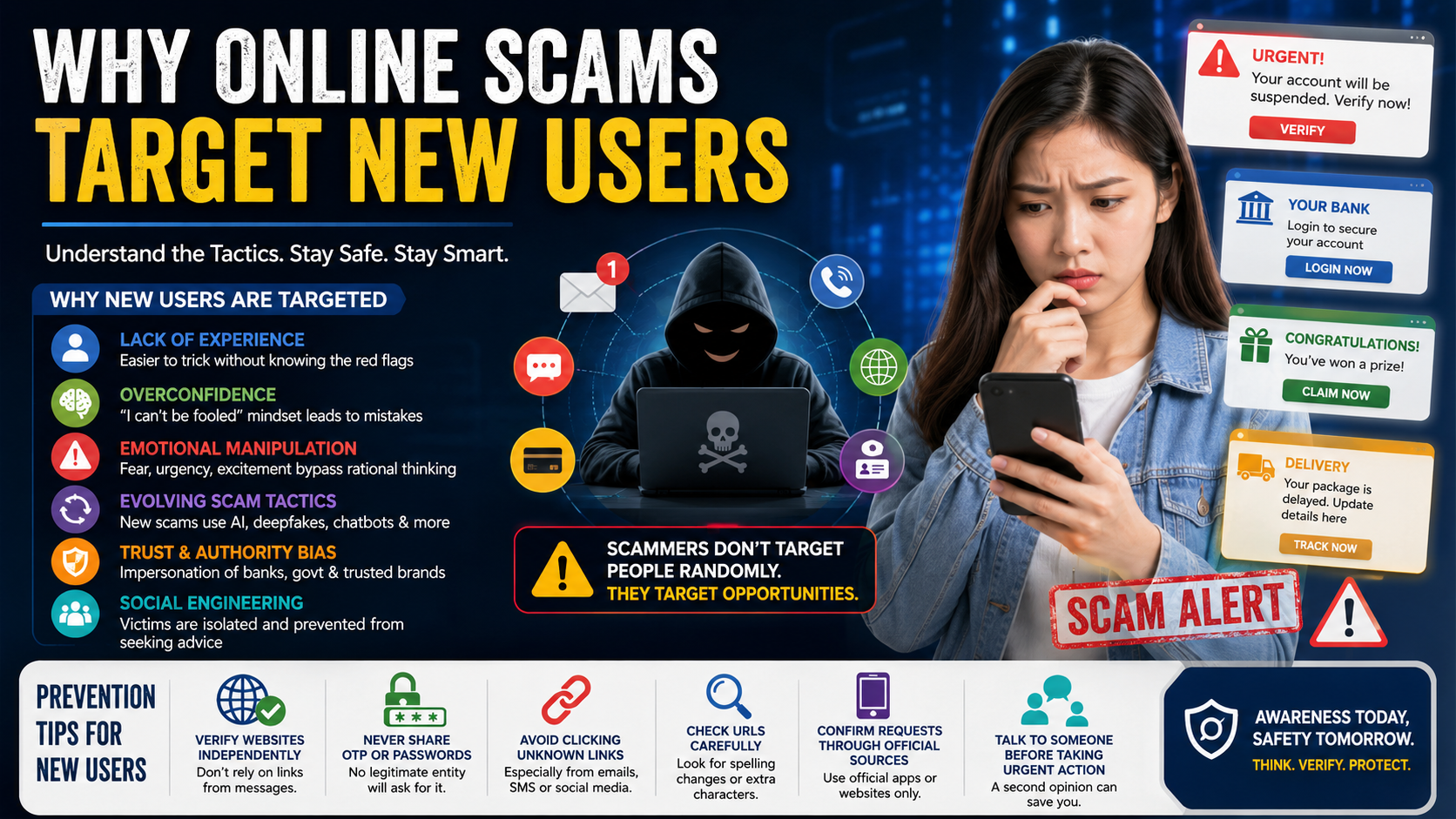
Why Online Scams Target New Users
Online scams have become one of the fastest-growing forms of cybercrime globally. As more people come online for banking, shopping, investing, and social networking, scammers are shifting their focus toward new and inexperienced users.
New users are often the easiest targets—not because they lack intelligence, but because they lack exposure to scam patterns. Fraudsters take advantage of this learning gap using emotional triggers, urgency, and trust manipulation.
Lack of Digital Experience Makes New Users Vulnerable
One of the biggest reasons new users are targeted is simple: inexperience.
According to research insights from ScamShield Singapore, first-time internet users often cannot distinguish between legitimate platforms and fake websites or messages ScamShield Insight.
New users typically:
- Do not recognize phishing emails or fake links
- Trust messages that look “official”
- Are unfamiliar with security warnings or red flags
Scammers exploit this learning curve by creating highly realistic replicas of banks, government portals, or delivery services.
Overconfidence in “Tech-Savviness”
Interestingly, being digitally active does not always mean being scam-aware.
A study from NUS highlights that younger and digitally confident individuals often assume they can easily detect fraud—but this confidence sometimes leads to careless decisions NUS Scam Research.
This creates a dangerous mindset:
- “I can’t be fooled”
- “I know how scams work”
- “This looks safe enough”
Scammers exploit this overconfidence by designing sophisticated scams that bypass basic awareness.
Emotional Manipulation is Highly Effective on New Users
Scammers don’t just rely on technology—they rely heavily on psychology.
New users are especially prone to emotional decision-making because they may not yet understand how scams create pressure.
Common emotional triggers include:
- Fear (your account will be blocked)
- Urgency (act within 10 minutes)
- Excitement (you’ve won a prize)
- Trust (impersonation of authority figures)
The Safer Internet Lab report shows that modern scams in Singapore increasingly use emotional manipulation combined with social engineering techniques Safer Internet Lab Report.
Lack of Awareness About Evolving Scam Tactics
Scams are not static—they constantly evolve.
New users often rely on outdated knowledge like:
- “Never share OTP”
- “Don’t click unknown links”
While true, modern scams go far beyond this. They now include:
- AI-generated voice calls (deepfake impersonation)
- Fake customer service chatbots
- Social media investment traps
- QR code scams (quishing)
Without updated awareness, new users may not recognize newer scam formats even if they know basic rules.
Trust in Online Authority and Branding
Another major reason new users fall victim is trust bias.
Scammers often impersonate:
- Banks
- Government agencies
- Delivery companies
- Popular e-commerce platforms
Because new users are not yet familiar with official communication styles, they tend to trust logos, email formats, and branding without verification.
This trust-based vulnerability is one of the most commonly exploited factors in online fraud cases.
Social Engineering and Isolation of Victims
Many scams deliberately isolate users during the interaction.
For example:
- “Do not tell anyone about this transaction”
- “Stay on the call while we fix your account”
- “Only you are eligible for this offer”
This prevents victims from seeking advice from friends or family.
New users, who may already feel uncertain, are more likely to comply without second opinions.
Why Scammers Prefer New Users Specifically
From a scammer’s perspective, targeting new users is efficient:
- Lower resistance to manipulation
- Higher chance of successful deception
- Less awareness of reporting systems
- Faster emotional response time
It is not about targeting individuals randomly—it is about maximizing success rates.
Prevention Tips for New Users
To reduce risk, new users should adopt simple but effective habits:
- Always verify official websites independently
- Never share OTP or passwords
- Avoid clicking unknown links
- Check URLs carefully for spelling changes
- Confirm requests through official apps or websites
- Talk to someone before making urgent decisions
Awareness is the strongest defense against scams.
FAQs
1. Why are new users more likely to fall for online scams?
Because they lack experience in identifying fake messages, websites, and psychological manipulation techniques used by scammers.
2. Are tech-savvy people safe from scams?
Not always. Studies show even digitally skilled users can fall victim due to overconfidence and advanced scam methods.
3. What is the most common type of online scam?
Phishing scams, fake investment schemes, and impersonation scams are among the most common globally.
4. How do scammers create urgency?
They use threats like account suspension or limited-time offers to push victims into quick decisions without thinking.
5. What should I do if I suspect a scam?
Stop communication immediately, do not share any information, and report it to local cybercrime authorities or official scam reporting platforms.
Final Thought
Online scams targeting new users are not just a technology problem—they are a behavioral and psychological challenge. Fraudsters exploit inexperience, trust, and urgency to manipulate victims into making quick mistakes.
The best protection is not just awareness of scams, but understanding how scammers think. Once users recognize the psychological tactics behind these frauds, they become significantly harder to deceive.
Digital safety is no longer optional—it is a necessary skill for anyone entering the online world.